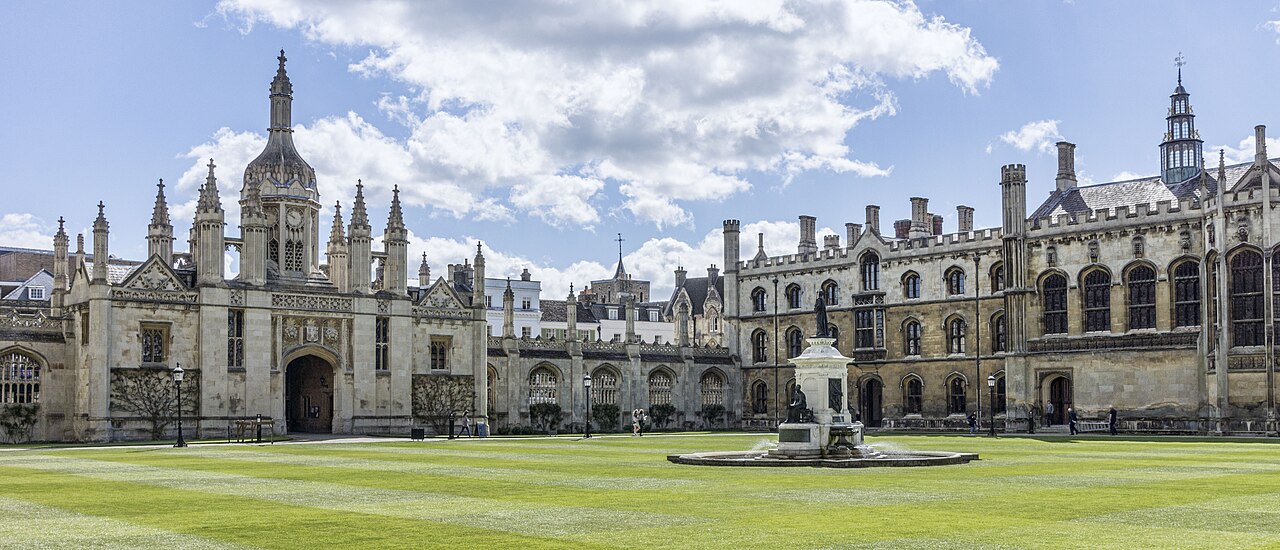
King’s College is one of Cambridge’s most recognisable communities: a place where late-medieval architecture, centuries of scholarship, world-famous choral music and contemporary research occupy the same few acres. Founded by Henry VI in 1441, the College has developed from a royal educational foundation into a diverse academic community at the centre of Cambridge.
A college shaped by continuity and change
The first impression of King’s is often architectural. The Chapel rises above King’s Parade and the River Cam, its vertical stonework and vast windows creating one of the defining silhouettes of Cambridge. Yet the College is more than its most famous building. Its courts, lawns, library, teaching spaces and student rooms form a working academic environment in which old structures are continually adapted to new purposes.
King’s began as a royal foundation closely linked with Eton College. Henry VI first planned a comparatively small institution, but his ambitions expanded to a college of seventy scholars. For centuries, admission was restricted to Etonians. Nineteenth-century reforms changed that settlement: non-Etonians were admitted from 1873, helping to transform the intellectual and social character of the College.
The College today presents itself as both heritage-rich and forward-looking. Its community includes undergraduate and graduate students working across the subjects offered by the University of Cambridge. Fellows contribute to research and teaching in disciplines ranging from the humanities and social sciences to mathematics, science and medicine.
Music is inseparable from the identity of King’s. The Choir of King’s College was established to sing services in the Chapel and has become an internationally recognised representative of the English choral tradition. The annual Festival of Nine Lessons and Carols, broadcast on Christmas Eve by the BBC since 1928, carries the sound of the Chapel far beyond Cambridge.
Five ways into King’s
History
Follow the College from Henry VI’s foundation through royal upheaval, reform and modern expansion.
Read the history →The Chapel
Discover the extraordinary building project that took more than half a century to bring to its great structural completion.
Explore the Chapel →The Choir
Learn how a fifteenth-century liturgical foundation became one of the world’s best-known collegiate choirs.
Meet the tradition →A college woven into the Cambridge landscape
Beyond the great courts, King’s opens onto lawns, trees and the River Cam — one of the settings that makes the College instantly recognisable.
At the heart of Cambridge
King’s occupies a remarkable position between King’s Parade and the Backs. This physical setting helps explain the College’s public presence: visitors encounter its architecture as part of the city, while members of the College experience the same landscape as a place of study, worship, conversation and everyday life. The contrast is part of King’s character. It is simultaneously an internationally known landmark and a residential academic community.
The College’s story is therefore not simply one of preservation. Its buildings have survived political conflict, religious upheaval and war, while its institutional life has repeatedly changed. That combination—continuity in place, change in people and ideas—is central to understanding King’s.
King’s today
King’s brings together the themes that make the College distinctive: a foundation stretching back to 1441, the architecture and worship of the Chapel, the international reach of the Choir, and a contemporary academic community within the University of Cambridge. These strands are not separate chapters so much as parts of the same place, continually shaping how King’s is studied, heard, visited and lived in.